Blog
Why Do Traders Keep So Much Capital in Stablecoins?
Traders keep part of that capital in stablecoins because they need an onchain balance that can settle trades, cover margin, and move between apps while they wait for the next opportunity.
Stablecoins have become core market infrastructure, and an April 2026 Federal Reserve note valued the market at $317 billion, more than 50% above early 2025.
TL;DR
- Stablecoins keep dollar-denominated capital onchain and ready to use.
- They are commonly used for settlement, margin, hedging workflows, and temporary risk reduction.
- Lending or investing stablecoins can produce a return, but it adds smart-contract, liquidity, and counterparty risks.
- With Own, supported eTokens can be deposited as collateral to borrow USDG while retaining the linked market exposure.
Stablecoins as Reserve Capital
Traders hold stablecoins as reserve capital: a relatively stable unit of account they can transfer, post as collateral, or deploy into another asset.
A balance such as USDG can serve as settlement cash, margin, and a risk buffer inside onchain markets.
That does not make stablecoins equivalent to cash in a bank account because they depend on an issuer, reserves, redemption channels, blockchain infrastructure, and secondary-market liquidity.
Reserve capital is the money a trader keeps available rather than committing to a directional position. Stablecoins fit this role because one onchain asset can perform several jobs.
One balance can support several workflows
A trader may use stablecoins for:
- Settlement: paying for an asset or receiving proceeds without first moving money through a bank.
- Margin: supporting derivatives positions. Hyperliquid's contract specifications, for example, specify USDG as collateral for perpetual contracts.
- Rebalancing: moving capital between spot assets, lending markets, derivatives, and other applications.
- Risk reduction: selling a volatile position into a dollar-linked asset when the trader wants less directional exposure.
- Optionality: keeping capital ready for a future entry, hedge, repayment, or liquidation buffer.
This flexibility matters because onchain markets operate continuously.
A wallet can transfer USDG at any time the relevant network and application are functioning, even when banks or traditional exchanges are closed.
A stable price simplifies planning
Reserve capital is easier to manage when its unit of account is predictable. A trader planning a $5,000 purchase or repayment does not want that balance to fall 12% before it is needed.
USDG is backed by highly liquid cash and cash-equivalent assets and is redeemable 1:1 for US dollars, subject to its terms.
Optionality has economic value
Cash waiting for a setup can look unproductive. Yet the ability to act quickly has value when spreads widen, collateral needs change, or an asset reaches a target price.
What Is the Opportunity Cost of Holding Stablecoins?
The opportunity cost is the return or exposure a trader gives up to keep capital stable and available, and it appears in three forms.
1. USDG does not produce a return by itself
USDG holders may not be entitled to that income.
A trader can supply USDG to a lending market like Own and receive interest-bearing aTokens.
2. Stable capital does not retain market exposure
USDG is designed to stay near one dollar. If a stock, tokenized stock, or crypto asset rises while a trader waits in USDG, the reserve does not participate in that rise.
The reverse also holds because stablecoins protect the reserve from a decline in those assets. Opportunity cost depends on what the trader would otherwise hold.
3. Readiness can justify a lower return
A trader who needs funds tomorrow has a different objective from one investing for three years. For immediate obligations, reliable access can matter more than yield or market exposure.
The useful question is not whether idle capital is always bad. It is how much reserve is actually needed, when it may be needed, and what risks are acceptable while waiting.
Three Ways to Keep $3,000 Ready
Assume a trader has $10,000 and wants at least $3,000 available for a future trade.
Route A: Hold all $10,000 in USDG
The full balance is ready to deploy. The trader has no linked stock exposure and no borrowing cost.
Route B: Hold $7,000 of exposure and $3,000 in USDG
The trader keeps exactly the planned reserve and commits the rest to the chosen asset. There is no debt, but only $7,000 participates in any price movement.
Route C: Hold $10,000 of supported eTokens and borrow $3,000 USDG
The trader keeps $10,000 of gross stock-linked exposure and receives $3,000 in usable USDG and the balance sheet is still $10,000 before costs:
- $10,000 of eToken collateral
- plus $3,000 of USDG
- minus $3,000 of debt
Borrowing does not create $3,000 of new wealth but it adds liquidity and debt at the same time. Interest grows the debt, and a decline in the collateral can move the position toward liquidation.
How Does Own Offer Another Source of Stablecoin Liquidity?
Own does not eliminate the need for reserve capital. It gives traders another way to source USDG when they hold a supported stock-linked eToken and want to keep that exposure open.
An eToken is an ERC-20 Collateral-Secured Token designed to track a real-world asset price.
It is not necessarily the underlying share and does not automatically provide legal ownership, voting rights, or other shareholder rights. Our guide to tokenized stocks explains why those distinctions matter.
Step 1: Acquire a supported eToken
Through Own Trade, a user can access supported eTokens using the available quote and conversion routes.
Own's design uses a per-asset Reserve Vault for matched tokenized-stock wrappers. Pooled liquidity-provider collateral covers net exposure outside that reserve.
Step 2: Deposit the eToken as collateral
Where supported, the user deposits the eToken into Own Borrow. The eToken is locked while the loan remains open, so it cannot be sold, transferred, or used elsewhere unless the debt is repaid or the position permits a withdrawal.
Step 3: Borrow USDG below the maximum
As of August 25, 2026, Own lists a 70% maximum loan-to-value ratio, an 80% liquidation threshold, and a 5% liquidation bonus.
But the maximum is a ceiling and not a target. So, starting at 30% loan-to-value leaves more room for price declines and interest than starting near 70%.
Own's borrowing rate combines an external base rate with a protocol premium. Both the rate and the outstanding debt must be monitored. While an eToken is held as loan collateral, any dividends attributed to it accrue to the vault rather than the borrower under the current design.
Step 4: Use the USDG with a repayment plan
The USDG can remain in reserve or be used elsewhere. Each additional application adds another dependency, so the trader needs a repayment plan.
To close the position, the user repays the USDG debt and accrued interest, then withdraws the eToken. Our guide to borrowing against stocks onchain covers loan-to-value, costs, and liquidation in more detail.
When Are Stablecoins Still the Better Choice?
Borrowing against an asset is not a substitute for every cash balance. Holding stablecoins directly may be more appropriate when:
- a payment, margin transfer, or purchase is due soon;
- the trader wants to reduce market exposure rather than preserve it;
- the required amount is too large to borrow with a conservative buffer;
- the source or timing of repayment is uncertain;
- borrowing rates and execution costs exceed the value of retaining exposure;
- the trader does not want liquidation or smart-contract risk; or
- the relevant eToken, network, or borrowing market is unavailable.
How Should a Trader Size a Stablecoin Reserve?
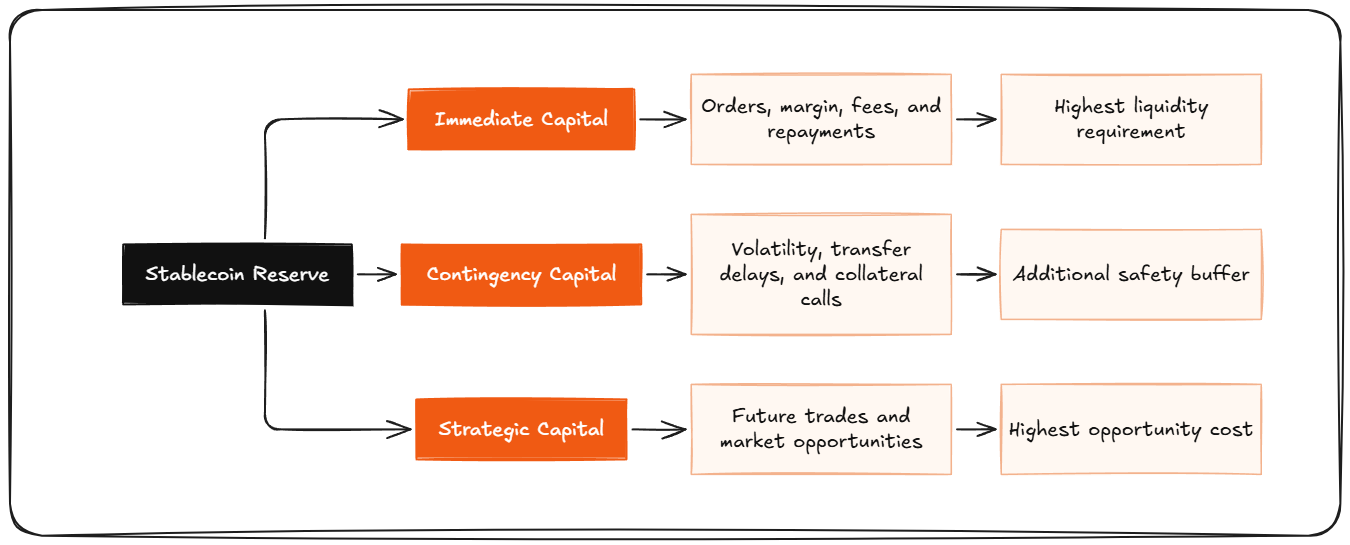
Start with liabilities and time horizons rather than a target percentage.
- Immediate capital: funds needed for open orders, margin, fees, or repayments in the next few days.
- Contingency capital: an additional buffer for volatility, delayed transfers, or an unexpected collateral call.
- Strategic capital: money reserved for opportunities that may appear later.
The first bucket generally needs the highest liquidity while the third has the clearest opportunity cost and deserves the most scrutiny.
If a trader plans to borrow the reserve, the stress test should include a collateral decline, higher interest, delayed redemption, and a stablecoin price deviation. A repayment source should exist independently of hoped-for appreciation.
What Can Go Wrong?
- Stablecoin risk: reserve, issuer, banking, regulatory, or redemption problems can push a stablecoin away from its target price.
- Liquidation risk: a falling eToken price or growing debt can push the loan past its liquidation threshold.
- Rate risk: a variable borrowing rate can make a position more expensive than expected.
- Oracle risk: delayed, incorrect, or disputed price data can affect collateral valuation and liquidation.
- Liquidity and redemption risk: exiting an eToken may depend on market makers, wrapper liquidity, Reserve Vault assets, and the applicable redemption path.
- Smart-contract and network risk: contract bugs, congestion, bridge failures, or application outages can prevent timely action.
- Composability risk: deploying borrowed USDG into another protocol adds its risks to the original loan.
FAQ
- Should I hold USDG or borrow it?
- Holding USDG is simpler when the need is immediate, permanent, or uncertain. Borrowing may suit a temporary need when retaining the exposure matters, the cost is acceptable, and the position starts with a conservative liquidation buffer and a credible repayment plan.
- Can I borrow stablecoins against tokenized stocks?
- Yes, where the asset is supported as collateral. With Own, supported eTokens can secure USDG loans. The user retains linked exposure while taking interest, liquidation, smart-contract, oracle, and liquidity risks.
- Does USDG earn interest while sitting in a wallet?
- No. Circle's terms state that USDG does not itself generate interest or a return. A user may deploy it into a lending or investment product, but that is a separate position with additional risk.
- Is USDG the same as cash?
- No. USDG is a token designed for 1:1 redemption. Direct redemption depends on eligibility and applicable restrictions.
- Why do crypto traders hold stablecoins?
- They use stablecoins for settlement, margin, accounting, future trades, and repayments. Stablecoins are less volatile than many crypto assets but retain issuer, reserve, redemption, and technical risks.