Blog
What Are Tokenized Stocks and How Do They Work?
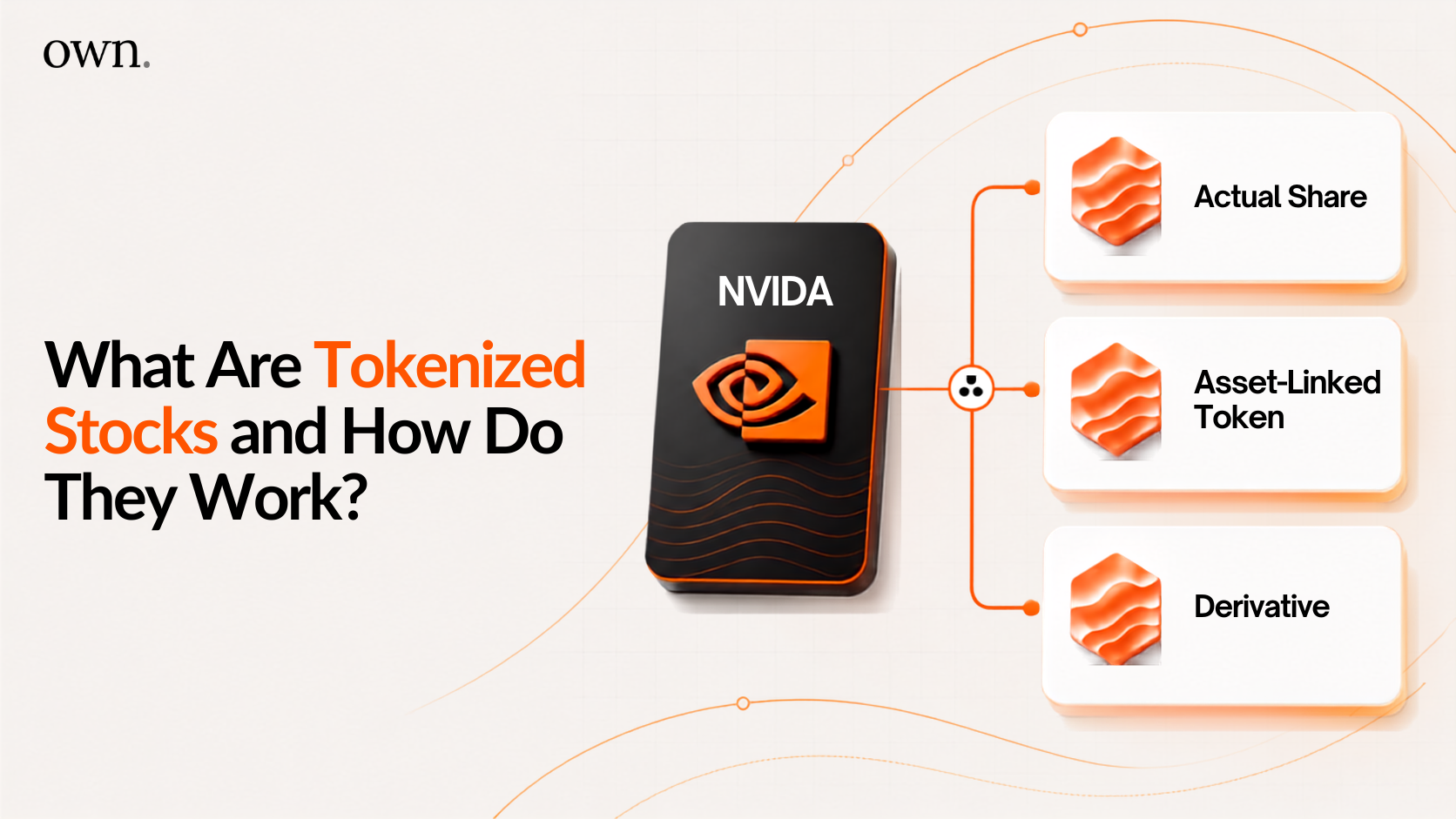
An NVDA token could be an actual Nvidia share recorded on a blockchain, a token linked to shares held with a custodian, or a derivative that tracks Nvidia’s price.
All three may be described as tokenized stocks even though the holder’s rights, counterparties, and exit routes differ.
As of July 28, 2026, RWA.xyz tracked about $2.33 billion in distributed tokenized stocks. The category includes equities issued directly onchain as well as synthetic representations, which is why the label alone tells you less than it first appears to.
What Are Tokenized Stocks?
A tokenized stock is a blockchain-based asset that represents a stock, a claim linked to a stock, or economic exposure to its price. Tokenized stocks are not always actual shares, so ownership rights, backing, redemption, and custody depend on how the product is structured.
A January 2026 SEC staff statement separates tokenized securities into two broad groups: securities tokenized by or on behalf of the issuer, and products created by third parties.
Third-party structures can include claims linked to securities held in custody or synthetic products that provide price exposure without giving the holder rights in the referenced security.
TLDR:
- A token that tracks a stock is not automatically the stock itself.
- Two tokens tracking the same ticker can give holders different legal and economic claims.
- Backing, custody, redemption, and shareholder rights depend on the product.
- Putting stock exposure onchain matters most when the asset can also be transferred, used as collateral, or integrated with other financial applications.
Do Tokenized Stocks Give You Ownership and Shareholder Rights?
Sometimes.
Galaxy’s tokenized GLXY is an example of direct tokenization. Galaxy’s filings state that Tokenized GLXY is a natively tokenized version of its Class A common stock, and holders retain the same rights and privileges as holders of traditional GLXY shares.
Other products use different structures.
xStocks use a different structure. Each xStock is a tracker certificate that provides economic exposure to an underlying equity, is collateralized 1:1 by that asset held with regulated custodians, and does not convey shareholder voting rights.
Robinhood Europe’s Classic Stock Tokens are derivative contracts that follow the price of an underlying stock. Holders do not own the underlying shares or receive voting rights, and the tokens cannot currently be sent to external wallets or platforms.
These differences affect voting rights, dividend treatment, redemption, custody, and what happens if one of the companies supporting the product fails.
A ticker tells you which market price the product follows. It does not tell you what legal claim you own.
How Do Tokenized Stocks Work?
There are two broad routes.
- Issuer-sponsored: The company or an authorized party tokenizes the security itself. The blockchain can become part of the ownership record, so an eligible token transfer also changes who holds the security.
- Third-party: Another company creates the token or financial instrument. In an asset-linked model, that company may arrange the purchase and custody of the underlying stock before issuing tokens against the position.
The token also needs a way to stay close to the price of the stock. Depending on the product, this can involve secondary-market liquidity, market makers, minting and redemption, arbitrage, and external price feeds.
Those mechanics become especially important when liquidity is thin or the underlying stock market is closed. We cover them separately in How Are Tokenized Stocks Backed, Priced, and Redeemed?
What Can You Do With Tokenized Stocks Onchain?
Tokenization does not change Nvidia’s earnings, Tesla’s margins, or the risk of owning either company. It changes the infrastructure used to record, transfer, settle, and potentially use the position.
In July 2026, DTCC processed DTC-tokenized securities in production transactions that included equity transfers, delivery-versus-payment settlement, securities lending, collateral pledges, and margin workflows.
For investors and financial applications, tokenization can support:
- transfers between compatible wallets or venues
- blockchain-based settlement
- lending through supported markets
- use as collateral
- integration with smart contracts and other onchain positions
Traditional securities can already be lent or pledged through brokers and financial institutions. The difference is the settlement rail and the ability, where supported, to connect the asset directly to blockchain-based applications.
Tokenization does not guarantee that freedom. Robinhood’s Classic Stock Tokens are recorded onchain, for example, but Robinhood currently does not support sending them to external wallets or platforms.
So “onchain” describes where part of the system runs. It does not, by itself, mean the asset is transferable, redeemable, or usable across DeFi.
Tokenized Stocks vs Stock Perpetuals: What’s the Difference?
Both can provide exposure to the same company, but they solve different problems.
A trader looking for leverage or short exposure may prefer a perpetual. Someone who wants stock-linked exposure that can leave the trading venue, sit in a wallet, or serve as collateral needs a transferable tokenized asset.
How Does Own Tokenize Stocks?
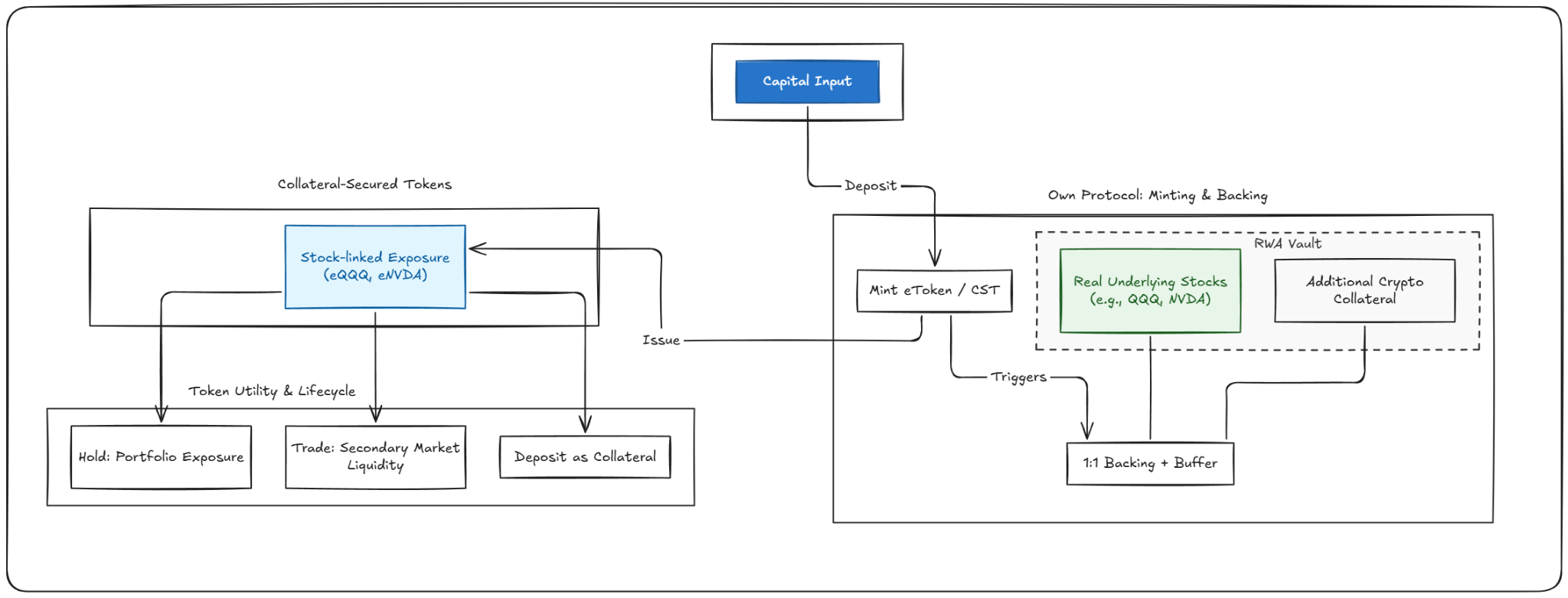
Own uses a Collateral-Secured Token (CST) model for stocks and other real-world assets onchain. Each eToken combines stock-linked reserves, crypto collateral, and built-in borrowing rather than functioning only as a token that tracks a reference asset.
For example, eQQQ tracks QQQ exposure but is not a share of the Invesco QQQ Trust and does not give its holder QQQ shareholder rights.
Under the CST design, real stock tokens back each eToken 1:1 in the RWA Vault. LP-supplied crypto provides an additional collateral layer, and the Lending Vault allows supported eTokens to be used as collateral for stablecoin borrowing.
The model differs from a simple stock wrapper because the stock-linked exposure sits inside a broader onchain system for reserves, collateral, and lending.
Borrowing against it introduces debt, interest, and liquidation risk. Those mechanics are already covered in How to Borrow Against Stocks Onchain, including how LTV changes as collateral and debt move.
What Should You Check Before Buying Tokenized Stocks?
Four questions cover most of what matters.
- What do I own?
Check whether the product is the actual security, a certificate, a claim linked to assets held elsewhere, or a derivative. This also tells you whether shareholder rights apply.
- What backs it?
Identify the issuer, custodian, reserves, collateral, and other parties required for the product to function.
- How do I get out?
Check secondary-market liquidity, redemption rights, transfer restrictions, and geographic or investor limitations.
- What can I do with it?
Find out whether the token can leave the platform, move between wallets, serve as collateral, or interact with other applications.
Two products can follow the same stock price while exposing their holders to different custodians, legal claims, redemption rules, and counterparties.
Compare those before comparing tickers.
FAQ
- Are Tokenized Stocks the Same as Stock Perpetuals?
- No. A stock perpetual is a derivative contract that uses funding payments and is often traded with leverage. “Tokenized stock” covers several structures and may describe an asset designed to be transferred or used outside a trading venue.
- Can Tokenized Stocks Trade 24/7?
- Some products support trading outside traditional exchange hours. Trading availability does not mean liquidity, minting, or redemption will be identical at every hour.
- Do Tokenized Stocks Give You Shareholder Rights?
- It depends on the structure. Galaxy’s filings state that Tokenized GLXY holders retain the same rights and privileges as traditional GLXY holders. Robinhood’s Classic Stock Tokens are derivatives and do not give holders ownership of the underlying shares or voting rights.
- Are Tokenized Stocks Real Stocks?
- Some are. Issuer-sponsored tokenized securities can represent the actual shares, while third-party products may instead use certificates, custodial claims, or derivatives linked to the stock.