Blog
How to Borrow Against Stocks Onchain (Without Selling Them)
Let’s say you hold $10,000 worth of eQQQ, an onchain token designed to track QQQ, and need $3,000 in stablecoins.
Selling part of the position would give you the money, but it would also reduce your QQQ-linked exposure.
One option is to deposit the tokenized stock as collateral in a DeFi lending market and borrow against it while keeping the original position open.
That does not make onchain borrowing better by default, but it can provide liquidity without selling the position.
What Does It Mean to Borrow Against Stocks Onchain?
Borrowing against stocks onchain means depositing a tokenized stock, such as eQQQ, as collateral in a DeFi lending market and borrowing stablecoins against its value without selling the position.
With Own, eQQQ can be used as collateral for a USDG loan where supported.
TLDR:
- You keep the QQQ-linked exposure while the loan remains open, but must repay the debt and maintain enough collateral to avoid liquidation.
- eQQQ is an eToken designed to track the price of QQQ. It is not a share of the Invesco QQQ Trust, so holding it does not give you legal ownership, voting rights, or other shareholder rights.
- Your eQQQ is the collateral, your borrowed USDG and accrued interest are the debt, and the distance to liquidation is your buffer. The collateral can fall while the debt grows.
Selling reduces the position, while borrowing keeps it open and leaves you responsible for the debt.
Why Borrow Against Tokenized Stocks Instead of Selling Them?
Selling is the simplest way to turn part of an eQQQ position into liquid capital, but the sold portion no longer benefits if QQQ rises. Borrowing lets you access liquidity while keeping the position open.
You might use the USDG for another trade, a hedge, or a temporary liquidity need while taking on debt to keep the exposure.
Is It Better to Sell Tokenized Stocks or Borrow Against Them?
Selling may be more appropriate if you already want to reduce your exposure or need permanent liquidity.
Borrowing may be worth considering when the need is temporary, retaining the exposure matters, and you can maintain a substantial buffer below liquidation.
How Does Onchain Borrowing Compare With a Traditional Stock-Backed Loan (SBLOC)?
A securities-backed line of credit (SBLOC) is arranged through a brokerage or financial institution against eligible securities. Onchain borrowing uses tokenized stocks as collateral in a DeFi lending market.
Neither is strictly better because the structure, access model, and risks are different.
- Access requirements: An SBLOC generally requires an eligible brokerage account, approved securities, identity checks, and lender approval. Onchain borrowing requires a compatible wallet, supported tokenized collateral, and access to the relevant DeFi market, subject to any product or jurisdictional restrictions.
- Operating hours: DeFi markets can generally be accessed onchain at any time, although the market for the underlying stock and some minting or redemption routes may follow traditional trading hours. SBLOC servicing and collateral operations usually depend more heavily on the broker’s business hours and processes.
- Who holds the collateral: With an SBLOC, the securities remain with the broker or custodian and are pledged to the lender. With onchain borrowing, the tokenized stock is locked in a smart contract while the loan remains open.
- Liquidation process: An SBLOC lender may issue a maintenance or margin call and can sell pledged securities under the loan agreement. A DeFi position can become eligible for automatic liquidation when its loan-to-value ratio crosses the protocol threshold, sometimes without a discretionary grace period.
- Shareholder rights: Securities pledged under an SBLOC may continue to carry shareholder rights subject to the account and loan terms. A tokenized stock may provide price exposure without legal ownership, voting rights, or other shareholder rights. eQQQ does not represent a share of the Invesco QQQ Trust.
- Added risks: An SBLOC adds lender, custody, rate, and forced-sale risk. Onchain borrowing adds smart-contract, oracle, stablecoin, liquidity, redemption, and network risks alongside price and liquidation risk.
The better route depends on eligibility, the required liquidity, how quickly you may need to act, which risks you can manage, and whether legal ownership of the underlying security matters.
How Does Borrowing Against Tokenized Stocks Work?
Where eQQQ is supported as collateral, you acquire or mint the tokenized stock, deposit it as collateral, review the borrowing capacity and liquidation parameters, and borrow USDG against its value.
You then monitor the collateral value, debt, interest, and loan-to-value ratio. To close the position, repay the USDG and accrued interest, withdraw the eQQQ, and continue holding it or use the applicable exit process.
Your borrowing capacity depends on the collateral value, approved parameters, the eQQQ price, and any position or market limits.
For a deeper explanation of the protocol mechanics behind eTokens, collateral, lending, and liquidation, read the Own whitepaper.
Loan-to-value ratio = Outstanding debt ÷ Current collateral value
A $3,000 loan against $10,000 of collateral starts at a 30% loan-to-value ratio. If the collateral falls to $8,000 and the debt grows to $3,059, the ratio becomes approximately 38.2%.
The maximum borrowing limit is a ceiling, not a target. Borrowing close to it leaves less room for declines, interest, and restoring the position.
What Does Borrowing Against Tokenized Stocks Cost?
The quoted interest rate is only one part of the cost. You may also pay transaction and network fees, trading or minting costs, spread and price impact when entering or exiting, and a liquidation penalty if the position crosses the threshold.
Locking eQQQ also means you cannot use that collateral elsewhere while the loan is open.
The total cost depends on the loan size, duration, rate, and exit conditions, especially if the position stays open longer than planned.
What Happens If You Borrow $3,000 Against $10,000 of eQQQ?
Consider this illustrative position with $10,000 of eQQQ collateral, $3,000 of borrowed USDG, a 30% starting loan-to-value ratio, an 8% annual borrowing rate, and a 90-day loan.
At a constant 8% rate, interest over 90 days would be: $3,000 × 8% × 90 ÷ 365 = $59.18
Repayment would require about $3,059.18 before other fees. The rate and period are illustrative, not current product parameters.
If eQQQ Rises by 15%
The collateral would be worth $11,500. With debt of approximately $3,059, the loan-to-value ratio would fall to about 26.6%, giving you more room before liquidation.
If eQQQ Stays Flat
The collateral remains near $10,000 while interest continues to accrue, so the loan-to-value ratio rises slightly. At the illustrative rate, you pay roughly $59 for 90 days of liquidity before other costs.
Whether that was worthwhile depends on how the borrowed USDG was used.
If eQQQ Falls by 20%
The collateral would decline to $8,000. With debt of approximately $3,059, the loan-to-value ratio would rise to about 38.2%, narrowing the liquidation buffer.
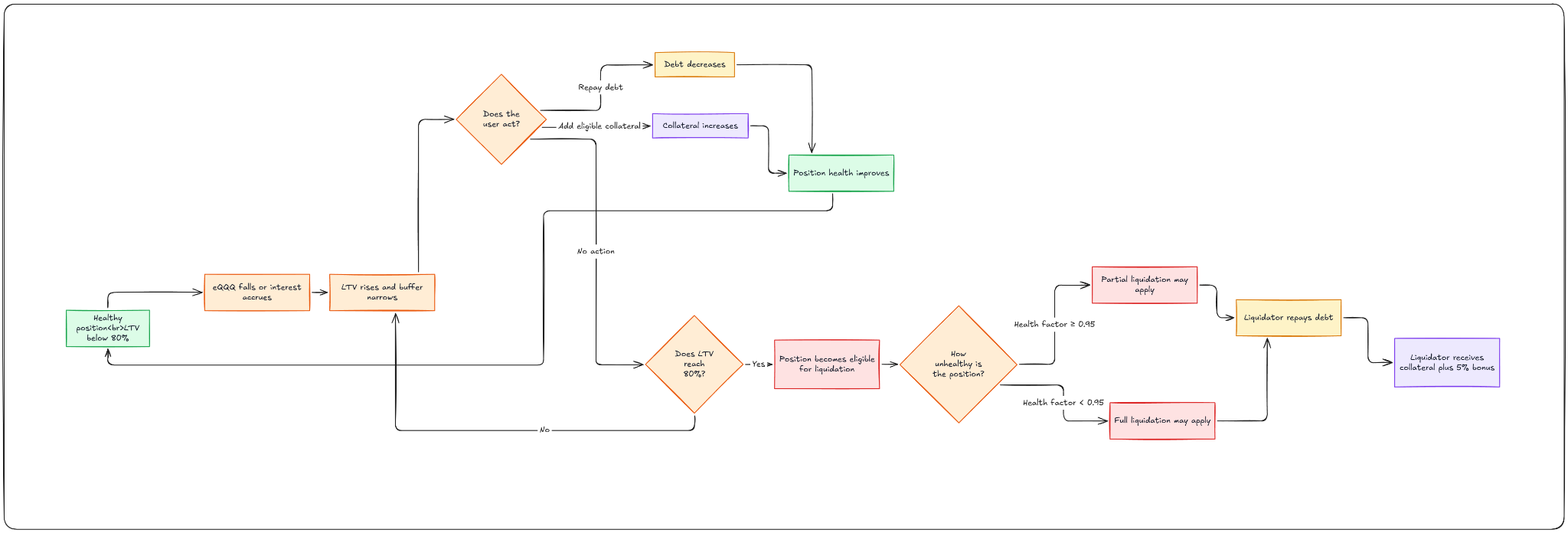
The exact liquidation point depends on the live threshold and price mechanism. At the documented 80% threshold, the position would become eligible at approximately $3,824 of collateral, a decline of about 61.8% from the starting value before fees.
Check the current parameters before opening a position.
When Can an Onchain Stock-Backed Loan Be Liquidated?
An eQQQ-backed loan can become eligible for liquidation when its loan-to-value ratio crosses the applicable threshold. This can happen because eQQQ falls, interest increases the debt, or the borrowing rate changes.
Before opening the position, check whether liquidation is partial or full, what penalty applies, which price feed values the collateral, and whether you have time to restore the position.
If the buffer begins to weaken, repaying part of the debt or adding eligible collateral can improve the position, provided you act before liquidation begins.
What Are the Risks of Borrowing Against Stocks Onchain?
- Price and liquidation risk means a fall in eQQQ can push the loan past its threshold.
- Borrowing-rate risk means a variable rate can increase the cost of maintaining the loan.
- Oracle and pricing risk comes from relying on a price mechanism to value the collateral and assess the position.
- Liquidity and redemption risk means trading or exiting eQQQ may depend on available liquidity, market makers, wrappers, and the applicable redemption process. Price exposure does not guarantee an immediate exit.
- Smart-contract risk exists because the contracts used for collateral, borrowing, repayment, and withdrawal may fail or behave unexpectedly.
- Stablecoin risk comes from borrowing USDG and relying on its liquidity and stability.
- Composability risk increases when you deploy the borrowed funds elsewhere and add new smart-contract, liquidity, or counterparty dependencies.
When Does Borrowing Against Tokenized Stocks Make Sense?
Borrowing may be worth considering when the need is temporary, retaining QQQ-linked exposure matters, and you have a defined source of repayment. The starting loan-to-value ratio should leave room for a decline.
The value of keeping the position open should exceed the interest, fees, execution costs, and additional risk. Expected appreciation alone is not a repayment plan.
When Is Selling the Tokenized Stock the Better Option?
Selling may be more appropriate when you want to reduce your exposure, need permanent liquidity, or cannot maintain a comfortable collateral buffer.
It may also be simpler when rates are high, repayment is uncertain, or you do not want liquidation, smart-contract, and stablecoin risk.
The better choice depends on whether retaining the exposure justifies taking on debt.
What Should You Check Before Borrowing Against Tokenized Stocks?
- Before opening a loan, check how much USDG you need and what your starting loan-to-value ratio will be. Review the borrowing rate, whether it can change, the liquidation threshold, the penalty, and how far eQQQ can fall before liquidation.
- Estimate the interest and entry and exit costs, review the available liquidity if you need to close or restore the position, and identify where the repayment funds will come from if the loan stays open longer than planned.
- Borrowing against tokenized stocks such as eQQQ can provide onchain liquidity without immediately reducing the linked market exposure. In return, it adds debt, ongoing costs, and dependencies across pricing, execution, liquidity, and redemption.
Model the downside first, then decide if retaining the exposure justifies the loan.
FAQ
- Can you borrow against stocks onchain?
- Yes, where a DeFi lending market supports the relevant tokenized stock as collateral. You deposit the token, borrow a supported stablecoin against its value, and maintain the required collateral buffer while the loan is open.
- How much can you borrow against tokenized stocks?
- The amount depends on the collateral value, the protocol’s maximum loan-to-value ratio, the specific asset parameters, and any market or position limits. The maximum is a ceiling, not a target, because borrowing near it leaves less room for price declines and interest.
- Is this the same as an SBLOC?
- No. Both let you borrow without immediately selling the exposure, but an SBLOC is provided through a broker or financial institution, while onchain borrowing uses tokenized collateral and smart contracts in a DeFi market. The custody model, access requirements, liquidation process, rights, and risks differ.
- What happens if the stock price falls while the loan is open?
- The value of the tokenized collateral can fall while the debt and interest remain outstanding, causing the loan-to-value ratio to rise. If it reaches the applicable liquidation threshold, the position may become eligible for partial or full liquidation under the live protocol rules.
- Does holding eQQQ give me shareholder rights?
- No. eQQQ is an eToken designed to track the price of QQQ, not a share of the Invesco QQQ Trust. Holding it does not provide legal ownership, voting rights, or other shareholder rights associated with the underlying trust.
- Where can I borrow against eQQQ?
- Where eQQQ is supported, you can use Own’s Borrow market to deposit it as collateral and borrow USDG. Confirm the live collateral parameters, rate, liquidation threshold, liquidity, and geographic availability before opening a position.