Blog
What Is Productive Collateral? A Guide to Capital Efficiency

Productive collateral is an asset that secures a loan or financial position while continuing to provide another economic function. It may preserve market exposure, keep generating income, release liquidity, or support activity elsewhere in a financial system.
The idea is familiar in traditional finance where an investor can pledge a securities portfolio instead of selling it.
Onchain markets make the same pattern programmable across crypto assets, yield-bearing tokens, and tokenized stocks.
TL;DR
- Idle collateral mainly protects the lender; productive collateral keeps another economic use while doing so.
- Productive does not always mean yield-bearing because retained price exposure and access to liquidity can also make collateral useful.
- A $3,000 loan against a $10,000 asset adds $3,000 of liquidity and $3,000 of debt, so net wealth is unchanged before costs.
- Onchain collateral is easier to integrate because smart contracts can value it, enforce LTV limits, and liquidate unsafe positions.
- At Own, supported eTokens can be posted as collateral to borrow USDC while the borrower keeps the eToken’s price exposure.
What Makes Collateral Productive?
The term is descriptive rather than a single legal or technical standard. In practice, collateral becomes productive when it does more than sit idle as security.
1. The asset keeps its market exposure:
Selling an asset removes exposure to the portion sold. Pledging it keeps the full position open, so the borrower continues to participate if its value rises and continues to lose if it falls.
2. The collateral may keep generating income
Some collateral continues to reflect staking rewards, lending interest, dividends, or other distributions while posted. Whether that income reaches the borrower depends on the asset and the loan agreement, so it should never be assumed.
3. The collateral releases usable liquidity
The lender advances another asset, often cash or a stablecoin, against the collateral’s value. The borrower can use that liquidity without first closing the original position.
4. The same asset can support a wider system
Onchain collateral can back loans, support liquidity, and interact with smart contracts under one set of transparent rules. This composability is useful, although each added dependency creates another path for losses or failure.
Productive Collateral vs Idle Collateral
Idle collateral performs one main job and that is giving the lender something to claim if the borrower cannot repay.
For example:
- Cash locked in a non-interest-bearing secured account is largely idle.
- A stock portfolio pledged to a credit line remains exposed to the stocks.
- A liquid staking token may continue reflecting staking rewards while securing a loan.
- A supported tokenized stock can preserve stock-linked exposure while making stablecoin borrowing possible.
How Does Productive Collateral Improve Capital Efficiency?
It improves capital efficiency by letting the same pool of value support more than one financial activity.
Suppose you hold $10,000 of a stock-linked token and need $3,000 of stablecoins. Selling leaves you with $7,000 of the original exposure and $3,000 in cash. Borrowing leaves the $10,000 position open and adds $3,000 of usable liquidity.
After borrowing: $10,000 collateral + $3,000 liquidity - $3,000 debt = $10,000 before interest and fees.
What can the extra liquidity do?
- Cover a temporary expense or working-capital need.
- Fund a hedge against another portfolio risk.
- Move into a time-sensitive opportunity without immediately selling the collateral.
What does the flexibility cost?
The debt accrues interest, the loan may carry transaction and execution costs, and the collateral becomes encumbered.
If the value created with the borrowed funds does not exceed those costs and risks, the extra use has reduced rather than improved efficiency.
How Do Productive-Collateral Loans Work Onchain?
Onchain lending uses smart contracts to hold collateral, calculate borrowing capacity, track debt, and enforce liquidation rules.
- The user deposits an accepted token into a lending contract.
- The protocol values it using its stated oracle or pricing method.
- The user borrows another asset up to the permitted loan-to-value ratio.
- Interest accrues, so the debt can grow even if the collateral price is unchanged.
- The user repays and withdraws the collateral, or the position can be liquidated if it becomes unsafe.
Where does LTV fit?
Loan-to-value, or LTV, is outstanding debt divided by current collateral value. A $3,000 loan against $10,000 of collateral starts at 30% LTV.
If the collateral falls to $6,250 while the debt remains $3,000, LTV rises to 48%.
Interest pushes it higher over time, which is why the maximum borrowing limit should be treated as a ceiling rather than a target.
Retained exposure works both ways
If the collateral rises, the position’s LTV falls and the borrower keeps the upside exposure. If it falls, the borrower absorbs the full decline while still owing principal and interest.
How Does Productive Collateral Work at Own?
Supported eTokens are Collateral-Secured Tokens, or CSTs, that track real-world assets and can be posted as collateral for USDC loans.
Step 1: Acquire an eToken
A user can request a firm market-maker quote in Own Trade and pay USDC to mint a supported eToken. Before doing so, the user should understand what tokenized stocks represent and how Own’s reserve and collateral layers support the eToken.
Step 2: Deposit it as collateral
The user supplies the supported eToken to Own Borrow. The app shows the position’s borrowing capacity and health, while the lending contract holds the collateral until the debt is repaid or liquidated.
Step 3: Borrow USDC conservatively
Own’s current documented launch configuration sets maximum LTV at 70%, the liquidation threshold at 80%, and the liquidation bonus at 5%. The lending book is also capped at 35% of the vault. These parameters are governance-adjustable, and the live interface should be checked before every position.
A user depositing $10,000 of a supported eToken could have up to $7,000 of initial borrowing capacity under that configuration, but choosing $3,000 starts at a more conservative 30% LTV.
If debt stayed at $3,000, an 80% liquidation threshold would be reached near $3,750 of collateral value. In practice, accrued interest, price updates, fees, and parameter changes can bring the threshold closer.
Step 4: Monitor, repay, and withdraw
The borrower tracks collateral value, debt, interest, and health. Repaying USDC and accrued interest releases the eToken; allowing the position to cross its threshold can cause automated liquidation.
There is also an important income detail: under the current design, dividend surplus associated with eTokens posted as active loan collateral accrues to the vault while the loan is open. The borrower retains price exposure but should not assume every economic benefit remains unchanged.
Our current lending parameters and money-flow documentation describe these mechanics in detail. For the practical risk calculations, see our guide to borrowing against stocks onchain.
How Does Productive Collateral Create Leverage?
Any collateralized loan adds debt to the balance sheet. The risk becomes more pronounced when the borrowed funds are used to buy another volatile asset, especially the same asset that was pledged.
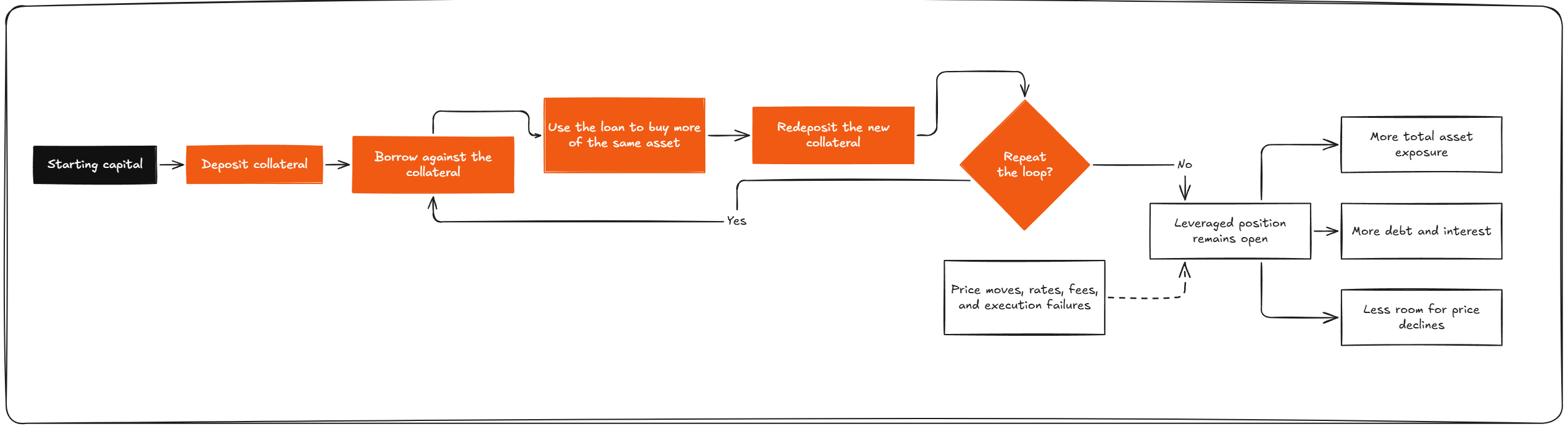
Recursive borrowing can amplify this further with deposit, borrow, buy more collateral, redeposit, and repeat options.
At a 70% maximum LTV, this loop can mathematically raise total asset exposure to about 3.3 times the user’s starting capital before fees and safety buffers, but operating near that limit leaves very little room for volatility.
- Borrowing for a defined expense creates debt but does not add another market position.
- Borrowing to diversify can spread exposure, although the debt and liquidation risk remain.
- Borrowing to buy more of the same asset compounds concentration and drawdowns.
- Looping the position increases sensitivity to price moves, interest, and execution failures.
When Does Productive Collateral Make Sense?
It may be a reasonable fit when:
- the liquidity need is temporary and clearly sized;
- retaining the asset exposure matters;
- there is a credible source and timeline for repayment;
- the starting LTV leaves room for a meaningful drawdown; and
- the expected benefit exceeds interest, fees, and added risk.
It may be a poor fit when:
- the borrower already wants to reduce the position;
- the need for cash is permanent or repayment is uncertain;
- rates are high relative to the expected benefit;
- the collateral is volatile or concentrated; or
- the strategy depends on maximum leverage or continual refinancing.
Selling is simpler when the goal is to exit risk but borrowing only makes sense when retaining the exposure justifies the debt and its dependencies.
What Are the Risks of Productive Collateral?
- Liquidation risk: falling collateral or rising debt can trigger an automated sale. SEC margin guidance makes the same basic point for traditional accounts: collateral can be sold without the investor controlling the timing.
- Interest-rate risk: a variable borrowing rate can make an initially sensible position expensive.
- Oracle risk: incorrect, delayed, or unavailable price data can affect borrowing capacity and liquidation.
- Smart-contract risk: bugs, compromised administrators, or network problems can disrupt deposits, repayments, or withdrawals.
- Asset-structure risk: a tokenized stock adds issuer, custodian, backing, legal, and redemption dependencies.
- Liquidity risk: closing or restoring a position can become expensive during volatile markets.
- Opportunity cost: pledged collateral may lose transferability, distributions, governance rights, or access to other uses.
FAQ
- Is productive collateral the same as yield-bearing collateral?
- No. Yield-bearing collateral is one form of productive collateral, but an asset can also be productive because it preserves exposure or enables borrowing without producing native yield.
- Does borrowing against an asset create extra wealth?
- No. The borrowed asset is matched by a debt of equal value at the start. Capital efficiency comes from flexibility, while interest and risk determine whether that flexibility was worthwhile.
- Can productive collateral be liquidated?
- Yes, if the loan structure includes liquidation and the position crosses its threshold. The exact trigger, penalty, and price source depend on the protocol.
- Can tokenized stocks be used as collateral?
- Only where a lending market supports the specific token. Compatibility does not remove the token’s issuer, custody, price, liquidity, redemption, or smart-contract risks.
- What can you borrow against eTokens at Own?
- Own’s current design supports USDC borrowing against eligible eTokens, subject to live collateral, LTV, capacity, and eligibility rules.