Blog
How Are Tokenized Stocks Backed, Priced, and Redeemed?
A tokenized stock can be backed by shares held with a custodian, a contractual claim, synthetic collateral, or a layered combination of assets.
But its price depends on a separate set of mechanisms: reference data, market makers, liquidity, minting, and redemption.
RWA.xyz showed about $2.54 billion of distributed tokenized-stock value on August 25, 2026, yet products tracking the same ticker can still give holders very different rights and exit routes.
TL;DR
- “Tokenized stock” describes a category, not one standard legal structure.
- A 1:1 backing claim should identify the asset, valuation method, custodian, legal owner, and redemption terms.
- Oracles provide reference prices. Market makers and arbitrage provide the trading activity that can pull a token toward that reference.
- Minting adds supply when demand is strong, while redemption removes supply when the token trades below its redeemable value.
- At Own, we combine stock-token reserves with pooled crypto collateral and multiple exit routes, reducing reliance on a single market maker or exit route.
What Actually Backs a Tokenized Stock?
A January 2026 SEC staff statement distinguishes third-party custodial tokenized securities from synthetic products, and that split is a useful starting point.
1. Shares held with a custodian
In a custodial structure, an issuer or affiliated vehicle acquires the referenced stock and holds it through a broker or custodian. The blockchain token represents a direct or indirect claim connected to that offchain holding.
This model can track the stock closely, but the holder still depends on the issuer, custodian, account segregation, and legal terms.
2. A certificate or contractual claim
Some products are tracker certificates, notes, or linked securities. The issuer may hold the referenced shares, but the tokenholder owns the issued instrument rather than becoming the registered shareholder of the company.
That can preserve price exposure and sometimes dividend economics without transferring voting rights or a direct claim against the underlying company.
Our guide to what tokenized stocks are compares these ownership models in more detail.
3. Synthetic collateral
A synthetic token tracks a stock through a contractual payoff, derivatives, or other collateral rather than one matching share for each token.
It can still follow the reference asset during normal markets, although the holder is exposed to a different set of counterparties and risk controls.
What Does “1:1 Backed” Really Mean?
Usually, 1:1 means the issuer reports one unit of backing for each token, or backing equal to each token’s value.
It does not automatically mean that one token is one registered share, nor does it guarantee instant redemption.
A useful backing claim should answer five questions:
- Unit: Is the match based on token count, share count, or market value?
- Ownership: Which entity legally owns the backing asset?
- Custody: Where is the asset held, and is it segregated from operating funds?
- Evidence: Is the reserve shown through an audit, an attestation, onchain balances, or some combination?
- Exit: Who can redeem, into what asset, at what price, and under which restrictions?
An attestation can connect reported offchain assets to onchain supply, but its scope and timing matter. It may be periodic, may exclude some liabilities, and is not necessarily the same as a full financial audit.
How Does a Tokenized Stock Track Its Price?
A tokenized stock normally has three related prices.
- Underlying price: the price of the traditional share on its primary market.
- Mint or redemption price: the issuer’s or protocol’s quote for creating or removing tokens.
- Secondary-market price: the price buyers and sellers agree on at an exchange or liquidity pool.
Suppose the stock trades at $100.
A market maker might quote $100.20 to sell the token and $99.80 to buy it back, while the last trade on a thin onchain pool prints at $100.40.
The gap can reflect spreads, fees, inventory, and demand rather than a broken product.
What do oracles do?
An oracle brings an external reference price onchain so a smart contract can value the token without trusting its latest trade. That helps prevent a small or manipulated pool from becoming the sole input for settlement or collateral calculations.
An oracle does not create buyers, provide cash, or guarantee redemption. If its data is stale, unavailable, or captured while the underlying market is closed, the protocol still needs rules for pausing, freshness, and acceptable deviation.
How do market makers and arbitrage help?
Market makers quote both sides, manage token and stablecoin inventory, and may hedge in the traditional market. Minting and redemption give them a way to adjust supply when the token moves away from its reference value.
- If a $100-backed token trades at $103, an eligible participant can mint near $100 and sell the new supply, which tends to push the token price down.
- If the token trades at $97, the participant can buy it and redeem near $100, removing supply and creating buying pressure.
Wide spreads, fees, eligibility rules, settlement delays, market closures, or a paused redemption channel can leave a premium or discount in place.
How Do Minting and Redemption Work?
Minting changes token supply; redemption reverses it. The precise sequence varies by issuer, but the economic flow is usually recognizable.
A simplified mint
- A buyer or market maker requests a quote for a defined number of tokens.
- The participant delivers cash, stablecoins, shares, or another accepted asset.
- The issuer acquires or allocates the required backing under the product’s rules.
- The contract mints the tokens and transfers them to the participant.
Some issuers pre-fund inventory so the user receives tokens before the underlying trade settles. Others wait for settlement, which is slower but reduces the period in which supply and reserves are out of sync.
A simplified redemption
- The holder or an approved participant submits tokens for redemption.
- The issuer calculates value using the stated price, ratio, spread, and fees.
- The tokens are burned or removed from circulation.
- The redeemer receives cash, stablecoins, shares, or an in-kind wrapper, depending on the terms.
Retail holders may not have direct access to the primary redemption channel. If only approved institutions can redeem, secondary-market liquidity and market-maker capacity become more important to the everyday holder.
What happens outside stock-market hours?
The blockchain token may trade when the underlying stock market is closed, but there is no new official stock-market price to copy. The onchain price becomes an estimate of where the share may trade when its market reopens.
If a stock closes Friday at $100 and its token trades Sunday at $105 after new information, the stock may catch up on Monday, the token may fall, or both may meet elsewhere. Continuous access does not mean continuous certainty.
How Does Backing and Redemption Work at Own?
At Own, we issue eTokens as Collateral-Secured Tokens, or CSTs.
Each eToken is designed to track a real-world asset, while the backing stack separates price-tracking reserves from the crypto collateral that covers residual exposure.
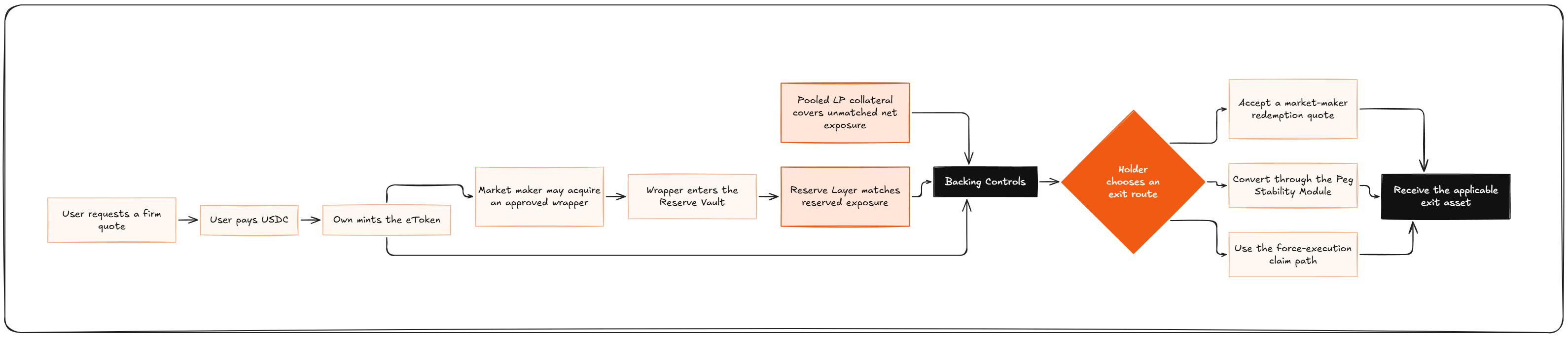
1. Users mint through a firm quote
A user requests a signed market-maker quote in Own Trade and pays in USDC. The quote sets the amount, price, and deadline, so the user knows the executable terms before submitting the transaction.
2. Market makers backfill the Reserve Vault
After taking the other side, a market maker can acquire an approved external stock wrapper and deposit it through the Peg Stability Module. The asset-specific Reserve Vault then holds wrapper value against the corresponding eToken supply.
3. Two layers support the eToken
- Reserve layer: approved wrapper tokens provide delta-one backing, matched 1:1 by value for the reserved portion.
- Collateral layer: pooled LP crypto collateral covers net exposure that is not matched by Reserve Vault value.
Under Own’s current launch configuration, net exposure cannot exceed 65% of counted LP collateral. In other words, each $1 of unmatched exposure requires at least about $1.54 of counted collateral. The limit is governance-adjustable and should not be read as a permanent parameter.
4. Holders have more than one exit route
- Accept a market maker’s redemption quote.
- Convert an eToken into an available approved wrapper through the Peg Stability Module.
- If normal liquidity fails, open a claim and use the protocol’s force-execution path after the documented window and price-proof requirements are met.
These routes reduce dependence on a single market maker, but they do not remove wrapper-issuer, oracle, smart-contract, collateral, or legal risk. Own’s backing documentation and current Own protocol guide explain the mechanics and governance-adjustable safeguards in detail.
Once minted, supported eTokens can also be posted in Own Borrow for a USDC loan. That lending position has its own interest, LTV, and liquidation risks, which we explain in our guide to borrowing against stocks onchain.
\
Figure 2. Own separates the minting path from the exit sequence, with reserve and collateral controls between them.
Where Can Backing, Pricing, or Redemption Fail?
The main failure modes are easiest to assess by function:
- Issuer and custody risk: reserves may be frozen, misallocated, encumbered, or exposed to insolvency.
- Evidence risk: an attestation may be stale, narrow in scope, or unable to show all liabilities.
- Oracle risk: delayed or incorrect data can distort quotes, settlement, and collateral values.
- Liquidity risk: market makers can widen spreads or withdraw during volatility.
- Redemption risk: eligibility, minimums, fees, jurisdiction, or settlement delays can block an expected exit.
- Smart-contract and collateral risk: code failures or falling safety collateral can weaken onchain protections.
A 1:1 label answers a reserve-ratio question. It does not, by itself, answer whether that reserve is enforceable, liquid, segregated, and available to the person holding the token.
What Should You Check Before Using a Tokenized Stock?
- What legal instrument do I own: a share, entitlement, certificate, wrapper, or synthetic claim?
- What assets back it, and who owns and custodies those assets?
- How current and complete is the reserve evidence?
- How are the reference price, spread, fees, and market-hours rules set?
- Who can mint and redeem, and what asset is delivered on exit?
- What happens if an issuer, custodian, oracle, market maker, or smart contract fails?
The product documents determine what the token represents when a holder needs to sell or redeem it.
FAQ
- What makes an Own eToken different from a simple wrapper?
- We combine asset-specific stock-token reserves, pooled crypto collateral for net exposure, RFQ and PSM conversion paths, and built-in borrowing. The design adds redundancy while keeping its trust assumptions visible.
- Does 1:1 backing remove risk?
- No. It can reduce reserve shortfall risk for the backed portion, but issuer, custody, legal, oracle, liquidity, redemption, and smart-contract risks remain.
- Can tokenized stocks trade 24/7?
- Some can trade around the clock onchain, even though the underlying exchange is closed. Outside market hours, the token price reflects onchain expectations rather than a fresh official share price.
- Why can a tokenized stock trade away from the stock price?
- The token has its own buyers, sellers, venue liquidity, spreads, and market hours. Price gaps can persist when minting or redemption is costly, delayed, restricted, or unavailable.
- Are tokenized stocks actual shares?
- Sometimes, but often they are not. Some tokens are part of the issuer’s official ownership record; others are custodial entitlements, tracker certificates, wrappers, or synthetic products.