Blog
Can Tokenized Stocks Really Trade 24/7?
Some tokenized stocks can trade on secondary markets at any hour, including weekends. That does not mean the underlying exchange, issuer, market makers, or redemption routes are equally available.
The blockchain may stay open while the reference market is closed. During that gap, prices rely more heavily on limited liquidity, market-maker inventory, and expectations about the next open.
TL;DR
- Some tokenized stocks trade 24/7 on supported secondary markets. Others operate 24/5 or follow a platform schedule.
- A token can remain transferable while the exchange is closed, but transferability does not guarantee liquidity.
- Off-hours prices can differ from the stock’s last official close because the underlying shares may not be available for immediate arbitrage.
- Minting, redemption, custody, corporate actions, and market-maker coverage can follow narrower schedules than onchain trading.
- Own eTokens can remain accessible outside market hours.
What Does 24/7 Trading Actually Mean?
“24/7” usually describes when a venue can process a trade and here's where we have four separate layers:
- Blockchain: Can the token move between compatible addresses?
- Venue: Is an exchange, market maker, or RFQ market accepting orders?
- Liquidity: Will someone trade the required amount at a reasonable price?
- Primary market: Can eligible participants mint or redeem against the backing?
A venue can be online on Sunday while its pool has little depth, its oracle is stale, or the issuer’s redemption desk is closed.
When Do Traditional US Stocks Trade?
The New York Stock Exchange lists its core session from 9:30 a.m. to 4:00 p.m. Eastern Time. Some NYSE markets provide early and late sessions on defined schedules.
Nasdaq lists pre-market trading from 4:00 a.m. to 9:30 a.m. and after-hours trading from 4:00 p.m. to 8:00 p.m. Eastern Time.
In a typical week without a market holiday, the 6.5-hour core session runs for 32.5 hours. That is roughly 19% of the week’s 168 hours.
Tokenization can extend access, but it cannot force the exchange to publish a new official price or reopen its order book.
How Can a Tokenized Stock Trade While the Stock Market Is Closed?
Once issued, a token can trade on a secondary venue. The trade changes who holds it, but not whether the stock exchange is open.
Available participants set the off-hours price using the last stock price, related markets, company news, and expectations about the next open.
The three prices to separate
- Official market price: The stock’s latest exchange price or official close.
- Reference mark: An oracle or pricing service’s estimate used for valuation and risk controls.
- Executable token price: The bid or ask available for the token on a specific venue and for a specific order size.
These prices can separate when the underlying market is closed or few participants quote.
Why off-hours spreads can widen
A market maker may align prices by buying one instrument and selling the other. That hedge becomes harder when the stock cannot trade or the issuer will not mint or redeem.
The maker carries gap risk until reopening and may widen its spread, reduce size, or stop quoting.
The SEC’s guidance identifies similar risks in extended-hours markets: lower liquidity, uncertain prices, wider spreads, fragmented venues, and greater sensitivity to news.
A Friday-Close and Sunday-Trading Example
Assume a stock finishes Friday’s core session at $100.
On Saturday, the company announces a promising new contract. The underlying exchange remains closed, but a tokenized version continues trading onchain.
By Sunday, its available market is:
- Best bid: $104
- Best ask: $108
- Last official stock close: $100
A buyer pays $108 for immediate execution but that is not an official weekend stock price. It is the seller’s price for carrying uncertainty until reopening.
- If shares begin Monday’s pre-market at $102 and the token converges, the Sunday buyer is down about 5.6% but the stock still opened 2% above Friday’s close.
- If shares reopen at $115, buying at $108 may look favorable. So, sunday’s token price is an estimate and not a guaranteed preview.
A $108 ask may cover only a small amount but A larger order can reach higher prices as it consumes available liquidity.
Does 24/7 Trading Mean 24/7 Minting and Redemption?
Usually not. xStocks states that supported secondary markets can trade its tokens 24/7. Issuer minting and redemption operate 24/5, with eligibility and minimums for direct access.
Tokens can change hands over the weekend while the issuer route for creating or removing supply is unavailable.
Robinhood’s Classic Stock Tokens follow a different model. They trade 24 hours a day from Monday to Friday, weekend orders can be queued, and the tokens currently cannot be sent to an external wallet or platform.
Two products can track the same ticker while offering different hours, transfer rights, exits, and counterparties.
What Keeps a Tokenized Stock Near the Underlying Price?
No single mechanism does all the work.
Market makers provide executable prices
Market makers use inventory, hedging costs, expected volatility, and order size to turn a reference price into an executable bid or ask.
Minting and redemption support arbitrage
Eligible participants can mint when a token trades high or redeem when it trades low. That arbitrage can narrow a price gap.
The link weakens when issuance, redemption, custody, or the stock market is unavailable.
Oracles provide a mark, not guaranteed execution
An oracle can provide a reference for settlement and risk checks. It cannot guarantee execution at that price.
How Does Off-Hours Access Work at Own?
At Own, we issue eTokens, or Collateral-Secured Tokens (CSTs), that track real-world asset prices.
The token and protocol contracts can remain accessible outside stock-market hours for transfers, supported collateral activity, and available mint or exit routes. It does not mean every eToken has a tight, instantly executable USDG market at every hour.
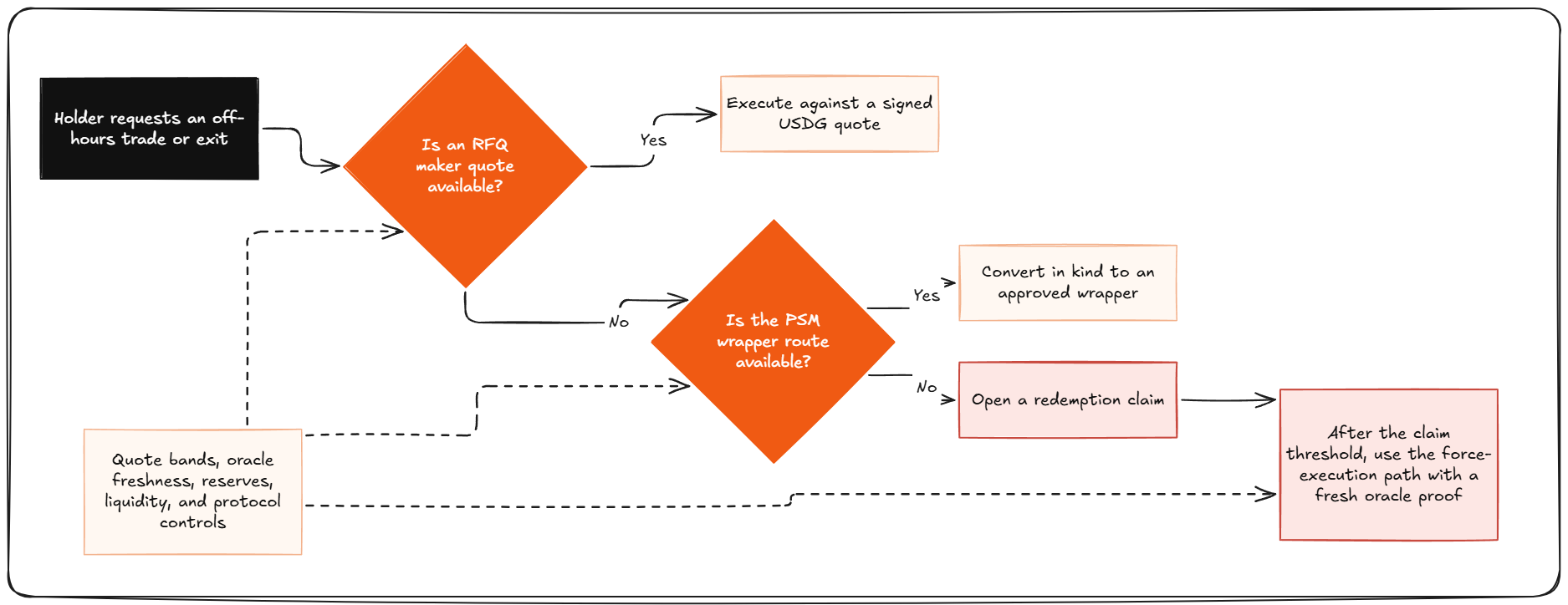
1. Trading starts with an RFQ
On Own Trade, a user can request a USDG quote to mint or redeem an eToken. Makers return signed, firm quotes with a price, size, and expiry.
A maker can price hedging costs and off-hours risk. If nobody quotes, the RFQ route has no immediate fill.
2. Quotes are checked against an oracle mark
Own validates settlement against a reference mark. The current launch configuration limits quotes to a governance-adjustable band and blocks new exposure against an excessively old mark.
The documented settings use a ±5% band and a mark no older than one hour for new exposure. These controls do not promise continuous liquidity.
3. The PSM provides an in-kind route
Own’s PSM converts approved wrapper tokens and the corresponding eToken in either direction. The protocol reference describes PSM conversion as permissionless and available outside market hours, including for halted assets, with no PSM protocol conversion fee.
In-kind redemption pays the approved wrapper token, not USDG. The wrapper’s issuer, venue, transfer, and redemption terms still apply.
4. Reserve and collateral accounting remain onchain
Each eToken has a protocol-owned Reserve Vault for stock-linked wrapper backing. Pooled LP crypto collateral secures the uncovered portion under one solvency ledger.
The backing does not close at 4:00 p.m. Its valuation still depends on valid inputs and the Own whitepaper’s controls.
5. The final exit is not an instant market trade
Own’s exit sequence starts with a maker fill, then PSM in-kind redemption. An unfilled redemption can later enter a claim and force-execution route at a fresh oracle price.
The launch design uses a 48-hour claim threshold and a two-minute oracle-proof freshness requirement. Both are governance-adjustable, and this backstop does not guarantee instant liquidity at the last stock price.
When Is 24/7 Access Actually Useful?
Depending on the token and protocol, a holder may be able to:
- move the asset between compatible wallets or applications
- post a supported eToken as collateral and borrow USDG
- redeem an eToken in kind through an available reserve route
- manage an onchain portfolio across time zones
Our borrowing guide explains those mechanics.
What Are the Main Risks Outside Market Hours?
- Liquidity risk: Fewer buyers, sellers, or market makers can mean partial fills or no fill.
- Spread and price-impact risk: The difference between the bid and ask may widen, especially for larger orders.
- Reference-price risk: The latest stock price may be old, while an oracle mark remains an estimate rather than an executable quote.
- Reopening risk: The underlying shares can reopen far above or below the token’s weekend price.
- Redemption-timing risk: The issuer, custodian, or eligible redeemer may operate on a narrower schedule.
- Fragmentation risk: Prices can differ across venues that do not share the same liquidity.
- Technology risk: Smart contracts, oracles, bridges, wallets, networks, or front ends can fail or pause.
- Product-structure risk: The token’s legal claim, transfer rights, backing, and counterparty exposure depend on its terms.
What Should You Check Before Trading a Tokenized Stock Off-Hours?
Before placing an order, check:
- Is this product available 24/7, 24/5, or only during a stated session?
- Can the token move to an external wallet, or is it confined to one platform?
- What are the current bid, ask, depth, and expected price impact for my order size?
- Which oracle provides the reference mark, and how fresh is it?
- Can eligible participants mint or redeem now, or is only secondary trading open?
- Does redemption return cash, USDG, the underlying security, or another wrapper token?
- What happens during a stock halt, corporate action, oracle failure, or network interruption?
Start with what a tokenized stock represents, then compare trading, liquidity, and exit access.
\
FAQ
- Does 24/7 trading make tokenized stocks safer?
- No. Longer access can add flexibility, but it can also expose traders to thinner liquidity, wider spreads, uncertain prices, reopening gaps, technical failures, and product-specific counterparty risks.
- Can Own eTokens be traded at any hour?
- Own’s contracts can remain accessible outside stock-market hours. A trade still requires an RFQ or PSM route, valid protocol conditions, reserves or liquidity, and a usable price input, so execution quality is not guaranteed.
- Why can the token price differ from the stock price?
- Liquidity, fragmentation, news, issuer availability, and limited arbitrage can create a gap that may narrow when primary markets reopen.
- Can I redeem a tokenized stock at any time?
- It depends. Secondary trading, issuer redemption, and in-kind redemption can have different schedules, minimums, eligibility rules, and payout assets.
- Is a Sunday token price the official stock price?
- No. It is an executable or last-traded price on that token venue. The underlying exchange’s official close remains the latest official stock price until its own market updates.
- Can tokenized stocks trade on weekends?
- Some can trade on supported secondary markets during weekends, but weekend access does not guarantee tight spreads, depth, fresh prices, or issuer redemption.